4 Things To Expect From Incognito

I just closed the final pages of Incognito. Again, beacuse I wanted to give this book a second reading to really nail down my feelings about it. Here's my thoughts -
 
1. The language was delightful. Eagleman uses alliteration poetically and knows how to coin a phrase. Just delightful.
2. I like footnotes actually at the foot of the page. I like to glance down and have the option to read them. I usually don't but I like having the option. Flipping to the back of the book each time I saw an asterisk got tiring.
3. With my psychology background, I was a little bored (I took a big nerdy interest in psychopharmacology early on). This was definitely meant for people who are not in the field or not really interested in the field. If you are said people, you'll be quite intrigued.
4. The ending was a little abrupt. I like reading a good old-fashioned hardback for many reasons, but a big one is momentum. When I'm just clicking arrows to finish a book (say, on my Kindle) I'm not mentally prepared to savor the ending. The same scenario occured here. The appendix, bibliography, etc., was about 40 pages long, so I felt like the book ended in the middle. Sad day.

Thank You For The Light by F. Scott Fitzgerald

Mrs. Hanson was a pretty, somewhat faded woman of forty, who sold corsets and girdles, travelling out of Chicago. For many years her territory had swung around through Toledo, Lima, Springfield, Columbus, Indianapolis, and Fort Wayne, and her transfer to the Iowa-Kansas-Missouri district was a promotion, for her firm was more strongly entrenched west of the Ohio.

Eastward, she had known her clientele chattily and had often been offered a drink or a cigarette in the buyer’s office after business was concluded. But she soon found that in her new district things were different. Not only was she never asked if she would like to smoke but several times her own inquiry as to whether anyone would mind was answered half apologetically with “It’s not that I mind, but it has a bad influence on the employees.”

“Oh, of course, I understand.”

Smoking meant a lot to her sometimes. She worked very hard and it had some ability to rest and relax her psychologically. She was a widow and she had no close relatives to write to in the evenings, and more than one moving picture a week hurt her eyes, so smoking had come to be an important punctuation mark in the long sentence of a day on the road.

The last week of her first trip on the new circuit found her in Kansas City. It was mid-August and she felt somewhat lonely among all her new contacts, so she was delighted to find at the outer desk of one firm a woman she had known in Chicago. She sat down before having herself announced and in the course of the conversation found out a little about the man she was going to see.

“Will he mind if I smoke?”

“What? My God, yes!” her friend said. “He’s given money to support the law against it.”

“Oh. Well, I’m grateful for the advice—more than grateful.”

The Professor and The Madman by Simon Winchester

Book: The Professor and the Madman
Author: Simon Winchester
 
Why I Read It: I was researching the origin of words for a class and I came across this story of how the Oxford English Dictionary was created.
First Line: In Victorian London, even in a place as louche and notoriously crime-ridden as Lambeth Marsh, the sound of gunshots was a rare event indeed.
 
First Impression: Murder, insanity and the making of the OED? I am definitely on board!
Last Impression: Wow. This was amazing. Much more story than history, which I was not expecting, but loved it from start to finish. Also, the dictionary entries at the beginning of each chapter were fun.


Ratings
Overall – 4 Heart Skipped A Beat
Characters – 4 The characterization of these two men is touching; figures from the past are usually brought alive from the pages of history with broad strokes, here they are detailed in their thoughts and actions, and tinted in a deferential light.
Story – 3 The story is equal parts history lesson and character study of the two men behind the first edition of the OED. The story is interesting, but it is not what drives the reader on.
Narration – 4 While most might find the subject a bit dull, Winchester clearly does not and his curiousity to discover the past is tangible on the pages. His description of dictionary history is tainted with wonder, and the reader can't help but share the awe at such a feat. His word choice, perhaps more noticable in a book about words, is careful and decisive. Each and every word used feels purposeful.

Read Again? I most certainly will read this book again. It was a fun piece of history that I have already had the craving to revisit.
Tell Others to Read? Depends upon the person. This book walks that line between creative nonfiction and historical fiction, so if the reader likes books in either of those genres, then yes.

Excerpt: And sometime in the early 1880s one copy, at least, left inside a book or slipped between the pages of a learned journal, found its way to one of two large cells on the top floor of Block 2 of the Broadmoor Asylum for the Criminally Insane in Crowthorne, Berkshire. It was read, voraciously, by William Minor, a man for whom books, with which one of his two cells was lined from floor to ceiling, had become a second life.
     Doctor Minor had been an inmate at Broadmoor for the previous eight years. He was deluded, true; but he was a sensitive and intelligent man, a graduate of Yale, and well read and curious. He was, understandably, preternaturally anxious to have something useful to do, something that might occupy the weeks and months and decades that stretched without limit -- "Until Her Majesty's Pleasure Be Known" -- before him.
     This invitation from a Dr. James Murray of Mill Hill, Middlesex, N.W., it seemed, promised an opportunity for intellectual stimulus -- and perhaps even a measure of personal redemption -- that was far better than any he could otherwise imagine. He would write, immediately.

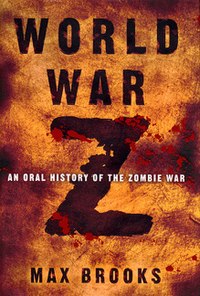
World War Z by Max Brooks

Book: World War Z
Author: Max Brooks

Why I Read It: Because I am a hard core zombie fan. And it looked awesome.
First Line: It goes by many names: "The Crisis," "The Dark Years," "The Walking Plague," as well as newer and more "hip" titles such as "World War Z" or "Z War One."

First Impression: Wow. This is really well written. And a brilliant idea.
Last Impression: Huh. Didn't really think about the impact of zombies on the planet. Or if they could survive drowning or freezing. A little more political than I was anticipating, but great angle to cover in an apocalyptic scenario.


Ratings
Overall – 5 Heart Racing
Characters – 5 Each and every character was unique and entralling; from regional accents to realistic slang, their voices jumped off the page.
Story – 5 The zombie apocalypse has been told many times, in many ways, ranging from horrorific to comedic, but this approach was brand new. Brooks is skilled in crafting a fluid narrative from the piece meal approach of first person accounts
Narration – 5 The journalistic structure of this "oral history" is well-crafted. The reader is drawn further in through each of the eight sections and the question and answer framework

Read Again? Absolutely. Willingly. Excitedly. And certainly around Halloween.
Tell Others to Read? Yes. Just about everyone. You don't have to be a zombie or horror fan to love this book. Also, you should stay ahead of the curve and read it before the movie comes out.

Excerpt: Two hundred million zombies. Who can even visualize that type of number, let alone combat it? At least this time around we knew what we were combating, but when you added up all the experience, all the data we'd compiled on their origin, their physiology, their strengths, their weaknesses, their motives, and their mentality, it still presented us with a very gloomy prospect for victory.
     The book of war, the one we've been writing since one ape slapped another, was completely useless in this situation. We had to write a new one from scratch.

An Abduction by Tessa Hadley

Jane Allsop was abducted when she was fifteen, and nobody noticed. This happened a long time ago, in Surrey, in the nineteen-sixties, when parents were more careless. She was home from boarding school for the summer, and day after day the sun rose into a cloudless sky, from which Jane couldn’t unfix the word “cerulean,” which she’d learned in the art room. (She wasn’t clever or literary, and was nervous of new words, which seemed to stick to her.) “Cerulean” was more of a blank, baking glare than mere merry blue.
 
It prised its way each morning like a chisel through the crack between Jane’s flowered bedroom curtains and between the eyelids she squeezed tightly shut in an effort to stay inside her dreams. It wasn’t acceptable in Jane’s kind of family to complain about good weather, yet the strain of it told on them, parents and children: they were remorselessly cheerful, while secretly they longed for rain. Jane imagined herself curled up with a bag of licorice beside a streaming windowpane, reading about the Chalet School. But her mother said it was a crime to stay indoors while the sun shone, and Jane couldn’t read outside with the same absorption; there was always some strikingly perfect speckled insect falling onto your page like a reminder (of what? of itself), or a root nudging into your back, or stinging ants inside your shorts.
 
The morning of the abduction, Mrs. Allsop—dishevelled in a limp linen shirtdress—was wielding her secateurs up a ladder, pruning the climbing roses. She was immensely capable; tall and big-boned with a pink, pleasant face and dry yellow hair chopped sensibly short. Jane admired her mother greatly, especially when she transformed herself at night, for a concert in London or a Rotary Club dinner, with clip-on pearl earrings and lipstick and scent, a frilled taupe satin stole. Jane coveted this stole and tried it on when her mother was at the shops, making sultry faces at herself in the mirror—although sultry was the last thing her mother was, and everyone told Jane that she looked just like her. She certainly seemed to have her mother’s figure, with not much bust, no waist to speak of, and a broad flat behind.

Creative Commons License
This work by H.E. Saunders is licensed under a Creative Commons Attribution-NonCommercial-NoDerivs 3.0 Unported License.