Showing posts with label #literarymusings. Show all posts

Stories of the Surreal

Very few fiction works capture the surreal as well as Ben Loory's book Stories for Nighttime and Some for the Day. It's lyrical and mythical and a break from the everyday. I guarantee you've never read a book like this one. Consider this whimsical line (my favorite from the entire collection):


"The octopus is spooning sugar into his tea 
when there is a knock at the door." 
  

Judging from its cover (which I heartily recommend), it's clear something unexpected will emerge from these pages. And Loory doesn't disappoint. Within you'll find:


Bizarre alien children.
A swimming pool inhabited by an invisible sea monster.
A house in love with the ocean, separated by a cliff.
Boys who die in, then fly from, the depths of wells.

But this book is not all delightful animals having a tea party. It covers everything from fairy tale to nightmare to folklore, so don't expect a strictly cheery time from its pages. There are stories here that have a darkness I have not experienced since learning that in the original Cinderella story, the stepsisters cut off their toes to fit in the glass slipper.

I am reminded of a few novels as I read this (Shadow Show, Light Boxes, and Beatrice and Virgil immediately come to mind), but there is no clear companion piece to this work, as it stands unique and alone.

I am amazed by Loory's talent as I peruse these tales and I am dying to dive into them again and again.


octopus graphic originally from this site.

Reading Bingo

This delightful reading bingo image was circulating the social media sites and I found it particularly inspiring. What a fun way to mix up your reading habit and get through all those books in your TBR list!
 
Of course other books will be reviewed here, but this seemed like a fun way to read those books currently sitting on TDBA shelves. The only rule was that each book had to be one I've never read. This is my personal list, so it is very science fiction, science, and nonfiction heavy, as those are some of my favorite genres. However, I encourage you to dig through your personal library and actual libraries near you to fill out your reading bingo.
 
So, without further ado, here is the list!

500+ pages - We, the Drowned by Carsten Jensen
Under 30 author - Hyperbole and a Half: Unfortunate Situations, Flawed Coping Mechanisms, and Other Things That Happened by Allie Brosh
One word title - Nightfall by Isaac Asimov
1st by fav author - Pebble in the Sky by Isaac Asimov
Book a friend loves - Enchantment by Orson Scott Card
Forgotten classic - War of the Worlds by H.G. Wells
Non-human characters - Beyond Human: Robots and Cyborgs by Benford and Malatre
Short stories - American Salvage by Bonnie Jo Campbell
Heard @ online - Death Comes to Pemberley by P.D. James
That scares me - Ocean at the End of the Lane by Neil Gaiman
Became a movie - The Road by Cormac McCarthy
Funny - Let's Pretend This Never Happened by Jenny Lawson
Bestselling - A Visit from the Goon Squad by Jennifer Egan
10+ years old - 2001: A Space Odyssey by Arthur C. Clarke
Published this year - Leaving the Sea: Stories by Ben Marcus
Female author - My Beautiful Genome: Exposing Our Genetic Future, One Quirk at a Time by Lone Frank
Different continent - Brave New World by Aldous Huxley
Based on a true story - Me Talk Pretty One Day by David Sedaris
2nd in series - The Dark Monk: A Hangman's Daughter Tale by Oliver Potzsch
Number in title - Catch 22 by Joseph Heller
Mystery - Murder on the Orient Express by Agatha Christie
Nonfiction - Space Chronicles: Facing the Ultimate Frontier by Neil deGrasse Tyson
Bottom of pile - Blood, Bones & Butter: The Inadvertent Education of a Reluctant Chef by Gabrielle Hamilton
Blue cover - Blue Like Jazz: Nonreligious Thoughts on Christian Spirituality by Donald Miller

Free Space - Moby-Duck: The True Story of 28,800 Bath Toys Lost at Seaand of the Beachcombers, Oceanographers, Environmentalists, and Fools,Including the Author, Who Went in Search of Them by Donovan Hohn


The First Story That Terrified Me

...or why I can never ever wear a green scarf.
 
In honor of All Hallow's Read and the giving of scary books, I wanted to share the first story that scared me. There have been great books since then that have creeped me out, made my hair stand on end, and made me keep the light on, but only one story can claim the title of my first scary story.  
 
When I was very young, I read In a Dark, Dark Room and Other Scary Stories by Alvin Schwartz. This book was for younger kids (6 to 8), so it was not graced with the truly terrifying images of some of his other books.
 
It did leave an impression on my young mind, however, and within its pages, I stumbled across a story that completely horrified me. After reading this story, I shoved the book away, covered it with a pillow, and couldn't bear to look at it for days after. Even today, rereading it gives me flashbacks to my childlike fear.
 
Here it is, for your spooky pleasure, The Green Ribbon.


The King On Writing

I have always had a begrudging respect for the "Master of Horror" Stephen King. While his genre is not my favorite, he has produced many classics and has become a legend. I mean, the general public recognizes his face. How often does that happen with authors? Rarely.

He's created some of the most classic horror stories of our generation, such as Carrie, IT, and The Shining. Even his novels that haven't become such classics are still unique and memorable: Salem's Lot, Christine, Misery, etc.

Though they have impacted the horror genre forever, I am still not a huge lover of his fiction works; Pet Sematary and Salem's Lot were great but Christine was predictable and about 100 pages too long and Dreamcatcher was forgettable.

But his novel for novelists, or at least those aspire to be so, was inspirational. I was blown away. Through an introduction that is very autobiographical, King maps out the path that took him to the page, and shares anything he feels might be useful for someone looking to find their own path. Note, he doesn't "give you the keys to the kingdom" because they simply don't exist.

He does talk about the importance of reading ("If you don't have time to read, you don't have the time (or the tools) to write"), having a place to write, setting goals ("I suggest a thousand words a day, and because I'm feeling magnanimous, I'll also suggest that you can take one day a week off, at least to begin with"), working with dialogue, and doing research, which is "a specialized kind of back story."

His narration is insightful, funny, and honest without pretension, and made me like him just a little bit more. I recommend this book to any author or person thinking about trying their hand at it. There is so much insight and inspiration between these pages, almost anyone who reads it will be putting pen to paper or fingers to keys.  But make sure your enthusiasm is prepared, because as the King says,

"You must not come lightly to the blank page."

Star Wars on Your Bookshelf


I am an unashamed fan of the original Star Wars movies, a staunch outcrier of the "new" trilogy and terribly nervous about whatever hell the new movies will bring. As a big sci-fi and fantasy reader, it was inevitable that Star Wars literature would end up on my bookshelf. I read through about four or five different authors and takes on the Star Wars universe before I ended up at A.C. Crispin's Han Solo trilogy. This trilogy is fan fiction as it should be done. Of all the Star Wars books I have read, this trilogy is the only one that puts me in the mood for the original experiences, which is what good fan fiction should accomplish. It should be new on its own, while holding true to the experience that created the fans.

Book one, The Paradise Snare, is by far my favorite. Han and Murgh, his Torogian cat friend, end up on the Yelsian pilgrimage world which is actually enslaving the pilgrims and forcing them to mine spice. The ruling sentients perform what's called the Exultation, a physical sensation that pushes the pilgrims to the brink of physical ecstasy. He falls in love for a young pilgrim from Corellia, his home world. After he realizes the truth behind the planet, he risks everything to free her.

Book two is the entitled The Hutt Gambit. Han's been kicked out of the Imperial Navy for saving a wookie from a life of slavery. The wookie (I'm sure you can guess who) swears a life debt to Han and the two seek work on the Smuggler's Moon in the Outer Rim. They end up in the employ of the Hutts as smugglers and high in their favor. As Palpatine gains power, he seeks to make an example of the Outer Rim, starting with Hutt territory. The Hutts withdraw their protection and leave the Smuggler's Moon to fend off the Imperial attack alone. Han's imperial experience and swagger unite the smugglers into a planned defense against the imperial attack.

Book three, Rebel Dawn, is the beginning of the Rebel Alliance. Han frustratingly disappears from the book as Hutts slither and battle, the Alliance grows and we see Lando. Destroying the Hutt slave enterprise will bring the Alliance recruits and spice to sell, and enough money to sit out a few runs for the smugglers who are guiding the way. It ends and all you want to do is watch the movies, to keep the world alive.

So if you're looking for a new adventure within the Star Wars world (and can't stand the sound of Darth Vader being referred to as "Annie"), then I cannot recommend these enough. The characters are true to their original inspiration and it's a fun read.

Fun Facts About The VNSA Booksale

The 57th annual VNSA booksale is just around the corner (Feburary 16-17) and hopefully your bookshelves are excited to receive all the new treasures. To get you even more excited about this year's fabulousness, here are some fun facts about the VNSA booksale and all of its awesomeness.
 

  1. It's not just for books. The VNSA sale has AV, audio, music and games.
  2. The trademark owl was drawn by Family Circus cartoonist Bill Keane.
  3. Members can't buy at the sale. It's true. They're participating for their love of literature. Thank them. Hell, even hug them. You wouldn't believe how much time they've put into this day. Each member works in their section all year, so they have touched each title numerous times and are willing to help attendees find just what they're looking for. "We do the damnedest to get people the book they're looking for," says VNSA volunteer Michele VonKampen. I believe it.
  4. It might seem like madness but it is actually a large-scale exercise in organization. There are 27 separate categories. Study the map before you go and know the difference between sections. For example "fiction" is anything 2003 or newer, "good reads" is 2002-1960 and "treasures" is anything 1960 or older. For the collectors items, stop by "rare and unusual." This is where I purchased my first first edition and I love it dearly.
  5. The different colored aprons are for different levels of participation with the booksale. Blue is for newbies, green is for 25+ years and orange is for 35+ years.
  6. Last year there were 1099 James Patterson books. Just imagine how many others are waiting to be discovered there this year.
  7. Any book VNSA thinks may not sell (overabundance of the title, less than pristine condition, etc) gets donated beforehand. Every book gets a good home :)
Now go impress your friends with your new found trivia and get even more stoked for this year's sale! Even more details can be found at the VNSA Book Sale Facebook page.

9 Unique Uses For a Dead Human Person


So, I've got a full on writer crush on Mary Roach. Fantastic. Fantastically amazingly fantastic. I found Stiff on my local Savers' shelf and scooped it up immediately. Not only had I been dying to read it for-e-ver, but it was a steal at $2. I am a bit dark in my tastes, so not all the information was new. But most of it was and all of it was written delightfully well. Now, for your reading pleasure, 9 unique uses for a dead human person. But please, please please please, pick up the work that inspired this list. It will be well worth your time. Promise.
 
1. Composting. I actually really like this idea. Instead of putting out noxious fumes to burn up flesh and bones to then pollute the air with ashes, why not give back to the earth? Try this instead: freeze dry your body, crush it up, mulch it and then nurture a memorial tree. I'm down. And I bet the tree will be grateful to.

2. Crash Test Dummies. I already was familiar with this idea, but reading about it made me more accepting of the practice. The floppy mannequinesque dolls that come to mind are only used once researchers know what levels of pressure to look for. And the only way to know how much pressure it takes to crack a human skull is to, well, crack a human skull. And when you think that 8,500 lives are saved a year by a few cadavers crashing into walls, it makes a lot more sense.

3. Penal Implants. You donate your skin with grand ideas of helping children burn victims. Which may happen. What also might happen- your skin is processed and used to cosmetically fill cougar's crows feet or make Mr. Tom's Little Tom a bit less little. But hey, I bet Little Tom is immensely grateful.

4. Forensic Decomposition. By far one of the grossest, and coolest, things to happen to a corpse. The University of Tennessee Medical Center runs a field research facility that studies the decomposition of human bodies under different, possible criminal, situations. Corpses are encased in concrete, left in shallow graves, left in car trunks, set adrift in ponds and stacked in garbage bags, to name a few. Chemical breakdown times are established by these disintegrating bodies which helps determine time of death. Police departments everywhere are grateful.

5. Sex. Yes, we've all heard of necrophilia, or more specifically, sexual actions with the deceased. But only 22 states have laws against it. So you'd better hope to die in Arizona or Nevada, because otherwise it's not a problem to have a good time before the embalming fluid sets in. I am quite sure this doesn't take place at the University of Tennessee Medical Center.

6. Human Mummy Confection. The basic idea is to steep a human cadaver in honey, let sit for a hundred years until it all congeals, then use medicinally. The story goes that aging Arabic men would eat only honey until it killed them. Then their bodies would be bathed and laid to rest in honey for the requisite century. The resulting substance would usually be applied topically, but at times it would be ingested for the patient to receive the full benefits. Honey has since been proven to have antibacterial properties, but I have yet to hear anything about the health benefits of cannibalism.

7. Face-lift Testers. Donated bodies that have been utilized for organs or other purposes can find their heads literally ending up on the chopping block. Sliced off at the chin, heads are placed in roasting pans and a few lucky plastic surgeons can tweak the techniques that keep housewives looking plastic.

8. Airplane Crash Detectives. When planes crash, usually the wreckage tells the story. When planes crash in the ocean, and sink, the plane may be irretrievable and aviation pathologists must study the "human wreckage." For example, if most of the passengers died from broken ribs, punctured lungs or ruptured aortas, it's a good indication that they had all been alive before they hit the water. If there were body parts strewn about or shrapnel in the bodies, it's likely there was an explosion. So, even if you didn't survive the crash, you could still have a short career as a detective.

9. Art Displays. German anatomist von Hagen developed an highly controversial art exhibit composed of plastinated human bodies. At the time Stiff was written, the exhibit, Koperwelten, was only touring Europe. Now most major cities have hosted an exhibit of Koperwelten, better known as BodyWorlds. I have seen it myself and have to say it's quite an experience. For the most part they look like models, but then you get close enough to see eyelashes and you remember this used to be a member of someone's family. Educational and impactful. I recommend checking it out.

Whew! Quite the list! For those of you who were intrigued, I strongly suggest picking up Stiff. You will love it. For all the rest of you, I still suggest it. It's just a killer awesome book.

Discovering The Ampersand


So, my learning about writing has taken me in the direction of typography today and I am loving it. Having a bit of a background in psychology, I find it very interesting why some fonts are more pleasing, when they should be used and how people react to them. (There's a fun article on fonts causing controversy here).

But one of the most fun things I have found amidst surfing the web today was the ampersand. It's everywhere and it's a fun way through which to experience typography. This website devoted itself entirely to the ampersand and it's tons of fun. From quirky to ugly to tattooed, you can experience the ampersand in every possible way. Apparently there's a poem paying homage to this little character as well:

"But you, ampersand, oh, your voluptuousness,
how your rolling, round curves save me
from a comma splice. Why don’t you
comma little closer"

This beautiful snippet delighted me and I just had to share it. You can find the rest of the poem here (quite worth reading but not as brilliant as this verse) and should definitely check out the poet.

The ampersand truly is a beautiful expression of type and a perfect canvas to illuminate all the intricacies and charm of each font. I hope you have as much fun as I, discovering the &.......


My 5 Desert Island Books

Okay, so we've all done the lists of 5 things you'd bring with you if you were stranded on a desert island..... movies, music, etc., but what we really care about is books! To quote Dale from The Walking Dead, "If I had known the world was ending I would have brought better books." Well, now we know: you're gonna be stranded on a desert island and you've got room for 5 paperbacks.

Sorry, your Kindle sinks like a rock.
No cheating.

Some of my favorite writers are not going with us. I love Vonnegut, Palahniuk, Bradbury, Orwell and many others, and it pains me to leave them behind. But a book that will be read and re-read must stand the test of time. If I haven't already read the book twice, it's automatically disqualified. Also, I must rule out books in a series. It would drive me crazy to have The Prisoner of Azkaban and not the Sorcerer's Stone.

1 - Water for Elephants by Sara Gruen. This is one of the books that take me places, and I'm taking it to our desert island as well. I breaks my heart to watch the movie massacre of Gruen's brilliance, but the pages themselves remain untainted by Hollywood fumbles. There is just so much to savor; the wonder of the circus, nostalgia for a simpler time, the darkness of the prohibition era and the danger of forbidden love. This story's beginning is my favorite on record and every time I put this book down I am satisfied.

2 - The Time Traveler's Wife by Audrey Niffenegger. A love affair played out backwards, this is probably the most romantic book I have read, with a fun sci-fi twist sprinkled in. The Hollywood attempt for this film fairs a little better but still falls short. This book shows the hard parts of a life - a hard marriage, a family tragedy, unrequited love, past secrets, loss, pain and loneliness - while still leaving the reader uplifted upon closing the pages. It's stunning every single time.

3 - I, Robot by Isaac Asimov. This book is a collection of short stories about, you guessed it, robots. Asimov chronicles the history of robotics (a term he coined, by the way) starting with the lovable robot nanny Robbie all the way up to a robot who can pass for a man. Every robot made is guided by the Three Laws of Robotics, programming ingrained in the circuitry of each mechanical sentient being. Each story is written as a mystery; trying to determine how a robot behaved in an unprogrammed way. If you think it sounds dull, I dare you to read it. I will certainly be reading it again.

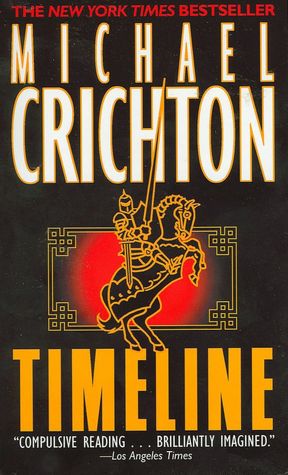
4 - Timeline by Michael Crichton. This is my most favorite of all Crichton's books and it is certainly the most fun to read time and time again. While I love the science that is the foundation to all of Crichton's realities, at times I feel it foreshadows the plot line more than I'd like. Absolutely not the case here. It's an unexpected adventure with characters I genuinely missed once I put the book down. Oh yeah, I forgot this one is a movie too. Please, don't judge the book by it's movie.

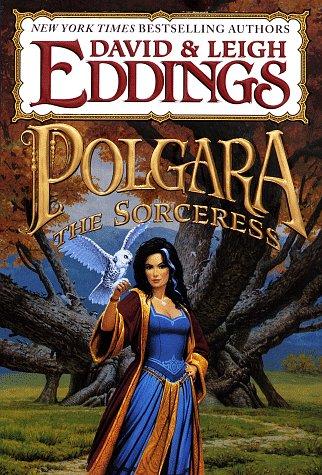
5 - Polgara the Sorceress by David Eddings. This is probably not one that many non-fantasy readers know about, but you should check it out. David Eddings wrote two fantasy series, the Belgariad and the Morallean, about a family of sorcerers charged with protecting the world from a vengeful vain and pouting deity. This book tells the story of Polgara, one of the main characters, apart from her adventures in the Belgariad and Morallean. So, I guess technically it's a prequel, but since it's not a necessary part of the series, I say it stays. Also, it's my list. Haha.

All right. Now it's your turn. You get 5 books to bring to our desert island. What are they gonna be?

A Grown-Up Peeta

I loved the character of Peeta in The Hunger Games series; he's loyal, caring and flat-out adorable. But, he's also under 18, which makes thinking he's adorable just a teeny bit weird. So, for all you adult women out there who liked the idea of liking Peeta, may I present the non-creepy grown up version: Geraden from Stephen R. Donaldson's series Mordant's Need.

The first book, The Mirror of Her Dreams, is the very first book I ever judged by its cover and I was completely thrilled that I did. It is now one of my life rules because it's usually quite successful. But I digress. It's a fantasy series, about a young woman named Terisa Morgan who suddenly has a strange young man, Geraden, arrive in her living room through her mirror. He comes from a world where mirrors serve as doorways rather than reflectors and he convinces her to travel back with him. The masters of mirrors are destroying the kingdom of Mordant and he thinks she can help stop them. It's a riveting story with well-crafted and memorable characters and I can't recommend it highly enough.

But we're here to discuss Geraden. He's initially described as having an undeniable inherent goodness and "the type of loyalty that is usually ascribed to puppies," an eagerness that outpaces his actions, which causes him to frequently embarrass himself. Throughout the first book, he is honed from a lovable, fumble-footed boy to a strong, protective and determined man and in the second book, this man grows into his strength. Re-reading the series (again) I found more similarities between Peeta and Geraden than I expected:
  • Their first concern is always the girl. Terisa and Katniss are ridiculously lucky to have these two looking out for them.
  • Each possesses an inherent goodness that he himself seems unaware of. The girls, of course, notice it right off the bat. Everyone loves a good guy.
  • They are honest and dependable. If they say they'll be there, they'll be there. And that's commitment.
  • They have a sense of humor that is just darn adorable. Not only are they good guys who aren't afraid of commitment, they're funny too.
  • Neither of them ever fails to make the right decision no matter how difficult. Both Peeta and Geraden find themselves in tough spots, but they always do what is right, not what is easy.

Donaldson's books are adult novels, so the romance is fully developed, less one-sided, and thus a bit more satisfying than the flirty hand holding of The Hunger Games. Not that there's anything wrong with hand holding. But grown ups have a little more imagination than that. So, for your grown up readings, I give you Geraden. Enjoy ladies!

PS - Guys, there's war and intrigue and betrayals and all kinds of other good stuff. You'll like this book too. Just like you liked The Hunger Games.

Another Reason Science Is Awesome

I have just picked up The Disappearing Spoon by Sam Kean, and so far, it is pretty good. It's much more of a chronological history of the periodic table, rather than the short story style exposition of 'true tales' I was expecting, and not as chock-full of delightful tidbits as I thought, but still all right. Reading it today, I realized that most of what Kean is discussing would probably be more impactful visually than as just words on a page. Turns out I was right. There are many interesting facts contained in the book that would make a good visual, but I figure, let's go with the namesake and see what a disappearing spoon actually looks like -


And that is a spoon melting ladies and gentleman! Turns out this is possible because of the element gallium. Gallium is solid at a moderate room temperature, but melts at 84 degrees Farenheit. As Kean says: "it's one of the few liquid metals you can touch without boiling your finger to the bone." Pretty cool, huh?

I think I want to watch superfluid helium defy gravity by flowing uphill and over walls next.....

3 Awesome Things I Learned About Planets

Astronomy is one of my favorite nerdy things. I suppose I can blame my dad for this overwhelming interest. You see, he’s an aeronautical engineer and has been involved in missions that involved the Hubble Telescope and the International Space Station. He’s actually walked around inside parts of the Space Station that are in orbit now and has a mission flag that was flown on a shuttle. I don’t know about you, but I think that’s cool as hell!

So naturally, How I Killed Pluto, is right up my alley. My inherited interest in space gave me a good background on much of what Brown talks about, but there were a few fun facts that I learned about our planets. Here are my favorite three (so far) -

1. We used to have 11 of them in our solar system. While we cry over the loss of little planet number nine, we’ve previously lost quite a few more. For 40 years our solar system consisted of Mercury, Venus, Mars, Earth, Jupiter, Saturn, Ceres, Pallas and Juno. When the definition of planet was narrowed, Ceres, Pallas and Juno were collectively demoted to asteroids. Apparently our generation isn’t alone in mourning a planet.

2. Our days of the weeks are named after our planets. Of course this was hundreds of years ago when the Sun and the Moon were planets. What’s that you say? We have no planet named Thurs? Well, you’d be correct! Mythology translated our planets into interesting names –

Sunday – the Sun. Pretty straightforward.
Monday – the Moon. Again, saw it coming.
Tuesday – Mars. Ah, it gets exciting. Mars is the Roman god of war. The Germanic God of war is Tiw, and it is for him we named Tuesday.
Wednesday – Mercury. Famous for being the winged-shoe messenger of the gods, one of his lesser known duties was serving as carrier of the dead. Or maybe still messenger. I suppose the gods have to deliver bad news too. Anyway, his Germanic Grim Reaper cousin is Woden, who gives us Wednesday.
Thursday – Jupiter. Jupiter is king of the gods, Thor is Norse king of the gods. Ta-da. Thursday.
Friday – Venus. Even though I think Venus, the Roman goddess of love, sounds more romantic, this day is named for her Norse counterpart Frigga.
Saturday – Saturn. Of course!

3. Our planets inspire names for the elements. I kind of guessed it with Plutonium, Uranium, Mercury, and so on. But Cerium and Palladium can thank the planets for their names as well. Fun random fact for parties.

I’m sure there’s many more delightful tidbits to be discovered, but I’ll let you find those for yourself when you pick up How I Killed Pluto.

4 Things To Expect From Incognito

I just closed the final pages of Incognito. Again, beacuse I wanted to give this book a second reading to really nail down my feelings about it. Here's my thoughts -
 
1. The language was delightful. Eagleman uses alliteration poetically and knows how to coin a phrase. Just delightful.
2. I like footnotes actually at the foot of the page. I like to glance down and have the option to read them. I usually don't but I like having the option. Flipping to the back of the book each time I saw an asterisk got tiring.
3. With my psychology background, I was a little bored (I took a big nerdy interest in psychopharmacology early on). This was definitely meant for people who are not in the field or not really interested in the field. If you are said people, you'll be quite intrigued.
4. The ending was a little abrupt. I like reading a good old-fashioned hardback for many reasons, but a big one is momentum. When I'm just clicking arrows to finish a book (say, on my Kindle) I'm not mentally prepared to savor the ending. The same scenario occured here. The appendix, bibliography, etc., was about 40 pages long, so I felt like the book ended in the middle. Sad day.

You Judge That Book By Its Cover

So, a long while ago, I decided that whole "don't judge a book by its cover" nonsense was just that; nonsense. My first outright disobedience to this archaic piece of wisdom proved very rewarding and since then I've never looked back. So as I scan my shelves looking for my next adventure, I start to look at books I've already devoured and and how much impact their cover had on my reading experience.

The first book that jumps out is The Art of Racing in the Rain. The story is about an old dog named Enzo who knows he is going to die (since he's getting up there in years) and all he wants is to be reincarnated as a racecar driver, like his owner Denny. It's a fine book. A quick read that is just right for someone who loves dogs or someone who is mildly fond of racing. But we're here to discuss the cover. If you haven't read the book, there's a (sorta) spoiler below, so just be warned. So, let's check out the differences, shall we?


The book on the left was what I saw throughout my reading experience. This cover of the book is very different from the new, more playful cover of the paperback version on the right. The second did not appear until long after I had closed the pages, and it got me wondering. How would I have read this book differently if Enzo had been looking at me like that? Probably very differently.

The dog on the left is looking away, unaware he's being seen. He's an adult and quite possibly old. There is no joy or happiness or puppy-ness on his face and instead he just looks tired. The dog on the right is engaging me; ears perked up, eyes on me, he looks curious as to what I am about to do. He may not be a puppy any longer, but he certainly looks young at heart.

Here's our spoiler: Enzo dies. Yes, I'm sure we all expected it to happen, but knowing can make it rough. Enzo knows it's coming but he's wishing for a happy reincarnation and a way back into Denny's life. The dog on the left prepared me for sadness; every time Enzo had an accident, was left abandoned or was in pain, my heart ached for him. I wish I would have been able to read it with the dog on the right greeting me. A dog that portrays optimism, hope, youthfulness and exuberance. This dog would have made the accidents, abandoning and pain a requisite necessity on his journey to a brighter (and hopefully faster) existence.

I wonder how Stein feels about his covers and if he knows what a somber overtone the looking-away Enzo cast over the reading experience. Perhaps that is why our new covers greet us cheerfully. But I know for certain that I wish the first time I read this book I was greeted by our youthful Enzo; perhaps then the feeling of subdued hopefulness would have easier to hold on to. Perhaps I'll pick the book up again, but if I do, you can bet I'm grabbing one of these sunnier and more adventurous covers!

Books That Take Me Places

Summer is drawing to a close, well, the summer of swimming pools, fireworks, barbeques and reunions. The blistering heat is still here. But the mood of summer is fading. Already it’s back-to-school-halloween-autumn in all the stores and all the travel plans are over. So every year, I fight back by embarking on a few last minute adventures from my library. I’ve compiled my favorite list of books that take me places. Now all you’ve got to decide is:

Where do you want to go?

Everywhere:
Read Travels by Michael Crichton. He ventures across the globe and into his psyche; literally everywhere. The narration mixes exotic explorations with personal discovery that makes for a seamless adventure read.

The most travelesque moment: the scuba diving section.


Travel Back in Time:
Read Water for Elephants by Sara Gruen. The circus-prohibition era just oozes off the page. The unique story and memorable characters are only part of the delight as she delicately recreates this age of wonder.

The most travelesque moment: the whole damn thing.


Travel To The Future:
Read Robots of Dawn by Isaac Asimov. Asimov walks the line between accessible and realistic; diehard sci-fi fans will love it and others will not be overwhelmed by scientific jargon. He creates a world that’s futuristic enough to be new, but same enough to be familiar.

The most travelesque moment: the main character’s life within the City.


Travel to a whole new crazy place:
Read Shades of Grey by Jasper Fforde. Fforde creates a chromatic society that is unexpected in a fun way. Spoons are a rare and cherished commodity, Greens don’t like Reds and no one likes Yellows and there is only one rabbit. Richly written and beautifully unique.

The most travelesque moment: the trek to a nearby uninhabited, dangerous town.


Travel to the afterlife:
Read The Lovely Bones by Alice Sebold. The journey from the living to the beyond is crafted with care and precision. Beautiful prose illuminates as unconscious expectations are realized; it's as if we always knew heaven would be like this.

The most travelesque moment: arriving in heaven.


So, whatever your inclination, we've got a destination.


Creative Commons License
This work by H.E. Saunders is licensed under a Creative Commons Attribution-NonCommercial-NoDerivs 3.0 Unported License.