Showing posts with label horror. Show all posts

Shadow Show: All-New Stories in Celebration of Ray Bradbury

Book: Shadow Show
Author: A collection of short stories by many authors, including Neil Gaiman, Audrey Niffenegger, Dave Eggers, Sam Weller, Mort Castle, and Alice Hoffman.
 
Why I Read It: It's a collection of short stories in celebration of Ray Bradbury, who I love. Also, I was traveling at the time and a book of short stories travels easier than one long novel sometimes.
First Line: Hmmm, doesn't really apply because there are 26 first lines.
 
First Impression: Oh my. So very very dark. And creative.
Last Impression: This was truly an homage to Bradbury; emotional, unique, unexpected and human.
 

Ratings
Overall – 5 Heart Racing As it usually is with a collection of shorter works by different authors, this book provided a mixed hat of tales. Some truly struck a chord with me and some I trudged through to get onto the next story. However, the overwhelming feeling was one of deep satisfaction.
Characters – 3 With short works such as these, it is the story that pulls the reader forward, rater than the characters, so many times they were forgettable.
Story – 5 Unabashedly brilliant. Though most of the 26 tales were a delight, a few stood out as exceptional: The Girl in the Funeral Parlor by Sam Weller, The Companions by David Morrell, Little America by Dan Chaon, Young Pilgrims by Joe Meno, and The Tattoo by Bonnie Jo Campbell stand out as truly memorable.
Narration – 4 Again, varied by work, but these artists are all experienced and each story is masterfully crafted.


Read Again? Absolutely. And again. And again.

Tell Others to Read? I recommended this book as I was still traveling through its pages. It is a very specific readership however, and is best enjoyed by true Bradbury fans (those who have read beyond Fahrenheit 451).

Excerpt from the Introduction:
      In Shadow Show, this celebration of Ray Bradbury, artists who have been profoundly influenced by him pen their own short stories in homage, stories that through image, theme, or concept are either ever so obviously or ever so subtle "Bradbury-informed." From the lyrical magic of Dandelion Wine, to the shifting sands of Mars, to the rolling mist of The October Country, Bradbury's literary achievements in all their scope are honored by a host of today's top writers. Shadow Show presents our most exciting authors, who, like the honoree, are not contained or constricted by category or locale, as they touch the Bradbury base for inspiration to explore their own singular, wildest imaginings.
     The stories in this volume are neither sequels nor pastiches but rather distinctive fictive visions by writers inspired by a single common touchstone: the enduring works of Ray Bradbury.
 
 
Content property of HarperCollins.

The Call of Cthulhu by H.P. Lovecraft

 
(Found Among the Papers of the Late Francis Wayland Thurston, of Boston)

“Of such great powers or beings there may be conceivably a survival . . . a survival of a hugely remote period when . . . consciousness was manifested, perhaps, in shapes and forms long since withdrawn before the tide of advancing humanity . . . forms of which poetry and legend alone have caught a flying memory and called them gods, monsters, mythical beings of all sorts and kinds. . . .”
—Algernon Blackwood.
 
I.

The Horror in Clay.
 
The most merciful thing in the world, I think, is the inability of the human mind to correlate all its contents. We live on a placid island of ignorance in the midst of black seas of infinity, and it was not meant that we should voyage far. The sciences, each straining in its own direction, have hitherto harmed us little; but some day the piecing together of dissociated knowledge will open up such terrifying vistas of reality, and of our frightful position therein, that we shall either go mad from the revelation or flee from the deadly light into the peace and safety of a new dark age.

      Theosophists have guessed at the awesome grandeur of the cosmic cycle wherein our world and human race form transient incidents. They have hinted at strange survivals in terms which would freeze the blood if not masked by a bland optimism. But it is not from them that there came the single glimpse of forbidden aeons which chills me when I think of it and maddens me when I dream of it. That glimpse, like all dread glimpses of truth, flashed out from an accidental piecing together of separated things—in this case an old newspaper item and the notes of a dead professor. I hope that no one else will accomplish this piecing out; certainly, if I live, I shall never knowingly supply a link in so hideous a chain. I think that the professor, too, intended to keep silent regarding the part he knew, and that he would have destroyed his notes had not sudden death seized him.

      My knowledge of the thing began in the winter of 1926–27 with the death of my grand-uncle George Gammell Angell, Professor Emeritus of Semitic Languages in Brown University, Providence, Rhode Island. Professor Angell was widely known as an authority on ancient inscriptions, and had frequently been resorted to by the heads of prominent museums; so that his passing at the age of ninety-two may be recalled by many. Locally, interest was intensified by the obscurity of the cause of death. The professor had been stricken whilst returning from the Newport boat; falling suddenly, as witnesses said, after having been jostled by a nautical-looking negro who had come from one of the queer dark courts on the precipitous hillside which formed a short cut from the waterfront to the deceased’s home in Williams Street. Physicians were unable to find any visible disorder, but concluded after perplexed debate that some obscure lesion of the heart, induced by the brisk ascent of so steep a hill by so elderly a man, was responsible for the end. At the time I saw no reason to dissent from this dictum, but latterly I am inclined to wonder—and more than wonder.

Christine by Stephen King

Book: Christine
Author: Stephen King

Why I Read It: I was on a scary book binge.
First Line: "This is the story of a lover's triange, I suppose you'd say--Arnie Cunningham, Leigh Cabot, and, of course, Christine."
 
First Impression: Well, I like old cars. This might be okay.
Last Impression: Oh my. So long winded and boring.


Ratings
Overall – 3 Resting Heart Rate The first 276 pages bored me to tears. It was clear what was happening to the car, to Arnie, to their friendship, to all of Christine's victims. Everything was evident, though his prose implied he felt it was suspenseful.
Characters – 2 The human characters were flat and boring. Christine, however, was a strong character, and that's what really matters as she is our main character. Still, she was very outnumbered in the novel, and the rest of the cast isn't engaging.
Story – 3 The majority of the story felt overly long and had no suspense, but the end of the book had me on the edge of my seat. The wrap-up was poetic and realistic.
Narration – 3 King is truly a great writer, but sadly not as talented as an editor. If he had cut the book by about 300 pages, I would have been there 100%.

Read Again? Most definitely not. I didn't enjoy it the first time, and there are much better Stephen King books out there.

Tell Others to Read? The one thing about Stephen King is you don't tell others to read him, you ask what they've already read. This book is a classic, for many good reasons, and I'm sure it sits on may shelves, well-worn and well-loved.

Excerpt: She was a bad joke, and what Arnie saw in her that day I'll never know. The left side of her wind shield was a snarled spiderweb of cracks. The right rear deck was bashed in, and an ugly nest of rust had grown in the paint-scraped valley. The back bumper was askew, the trunk lid was ajar, and upholstery was bleeding out through several long tears in the seat cover, both front and back. It looked as i fsomeone had worked on the upholstery with a knife. One tire was flat. The others were bald enough to show the canvas cording. Worst of all, there was a dark puddle of oil under the engine block.
     Arnie had fallen in love with a 1958 Plymouth Fury, one of the long ones with the big fins. 


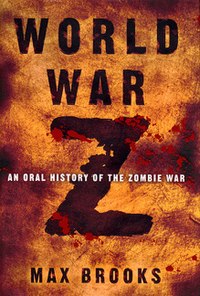
The After Effects of World War Z


If you like George Romero’s movies, the mythology of the zombie and are addicted to watching The Walking Dead, then you cannot miss this book. And even if you aren’t really a big horror or zombie fan, you should still pick this up.
 
World War Z is a journalistic-style retelling of the plague years and the ensuing zombie war. For zombie fanatics, like myself, this book presents a unique version of the zombie apocalypse. The world Brooks created is realistic; it retains vestiges of the world we know, with enough realism in the new details to seamlessly tie the two together. This is how the world could be after a zombie apocalypse. Each character tells their own story within the framework of the disaster and there are enough gaps in the overall tale to make it realistic. Not all parts of the story are intact, because not everyone survived and those viewpoints simply cannot be represented.
 
The book is constructed from individual characters and their personal accounts of World War Z. The stories of the characters take the reader from the International Space Station to the depths of the ocean (the undead don’t drown apparently); from the first interaction when patient zero is discovered in China, to a veteran reflecting on his battle memories. Through the varying viewpoints, the history of World War Z is fleshed out. It was a pleasure to read such a refreshing take on zombies. A work must be quite good to stand out from the ever-increasing body of zombie media and this stands out.

Even if you don’t love zombies or horror, I would still recommend this book. The narration is strong and unique, the characters are dynamic and engaging, and the pacing draws you in, creating an addictive pull towards the pages. And after reading it, you’ll have your own 10 cents to put in during the next inevitable zombie discussion.

The book is broken down into sections - Warning, Blame, Great Panic, Turning the Tide, Homefront USA, Around the World and Above, Total War, and Goodbyes. The last section, entitled Goodbyes, is a wrap-up of some of the characters, sometimes only two lines. It leans toward the sentimental, but is not as powerful as it could have been. It is difficult to keep track of the each individual character introduced in the previous seven sections.

But this is my only hesitation in what is otherwise resounding praise. I had to go back and find the character's original story and reread it, then follow it up with the "goodbye." And if the only negative thing I have is that you must reread this book, well, that's not so bad.

World War Z by Max Brooks

Book: World War Z
Author: Max Brooks

Why I Read It: Because I am a hard core zombie fan. And it looked awesome.
First Line: It goes by many names: "The Crisis," "The Dark Years," "The Walking Plague," as well as newer and more "hip" titles such as "World War Z" or "Z War One."

First Impression: Wow. This is really well written. And a brilliant idea.
Last Impression: Huh. Didn't really think about the impact of zombies on the planet. Or if they could survive drowning or freezing. A little more political than I was anticipating, but great angle to cover in an apocalyptic scenario.


Ratings
Overall – 5 Heart Racing
Characters – 5 Each and every character was unique and entralling; from regional accents to realistic slang, their voices jumped off the page.
Story – 5 The zombie apocalypse has been told many times, in many ways, ranging from horrorific to comedic, but this approach was brand new. Brooks is skilled in crafting a fluid narrative from the piece meal approach of first person accounts
Narration – 5 The journalistic structure of this "oral history" is well-crafted. The reader is drawn further in through each of the eight sections and the question and answer framework

Read Again? Absolutely. Willingly. Excitedly. And certainly around Halloween.
Tell Others to Read? Yes. Just about everyone. You don't have to be a zombie or horror fan to love this book. Also, you should stay ahead of the curve and read it before the movie comes out.

Excerpt: Two hundred million zombies. Who can even visualize that type of number, let alone combat it? At least this time around we knew what we were combating, but when you added up all the experience, all the data we'd compiled on their origin, their physiology, their strengths, their weaknesses, their motives, and their mentality, it still presented us with a very gloomy prospect for victory.
     The book of war, the one we've been writing since one ape slapped another, was completely useless in this situation. We had to write a new one from scratch.
Creative Commons License
This work by H.E. Saunders is licensed under a Creative Commons Attribution-NonCommercial-NoDerivs 3.0 Unported License.