The Professor and The Madman by Simon Winchester

Book: The Professor and the Madman
Author: Simon Winchester
 
Why I Read It: I was researching the origin of words for a class and I came across this story of how the Oxford English Dictionary was created.
First Line: In Victorian London, even in a place as louche and notoriously crime-ridden as Lambeth Marsh, the sound of gunshots was a rare event indeed.
 
First Impression: Murder, insanity and the making of the OED? I am definitely on board!
Last Impression: Wow. This was amazing. Much more story than history, which I was not expecting, but loved it from start to finish. Also, the dictionary entries at the beginning of each chapter were fun.


Ratings
Overall – 4 Heart Skipped A Beat
Characters – 4 The characterization of these two men is touching; figures from the past are usually brought alive from the pages of history with broad strokes, here they are detailed in their thoughts and actions, and tinted in a deferential light.
Story – 3 The story is equal parts history lesson and character study of the two men behind the first edition of the OED. The story is interesting, but it is not what drives the reader on.
Narration – 4 While most might find the subject a bit dull, Winchester clearly does not and his curiousity to discover the past is tangible on the pages. His description of dictionary history is tainted with wonder, and the reader can't help but share the awe at such a feat. His word choice, perhaps more noticable in a book about words, is careful and decisive. Each and every word used feels purposeful.

Read Again? I most certainly will read this book again. It was a fun piece of history that I have already had the craving to revisit.
Tell Others to Read? Depends upon the person. This book walks that line between creative nonfiction and historical fiction, so if the reader likes books in either of those genres, then yes.

Excerpt: And sometime in the early 1880s one copy, at least, left inside a book or slipped between the pages of a learned journal, found its way to one of two large cells on the top floor of Block 2 of the Broadmoor Asylum for the Criminally Insane in Crowthorne, Berkshire. It was read, voraciously, by William Minor, a man for whom books, with which one of his two cells was lined from floor to ceiling, had become a second life.
     Doctor Minor had been an inmate at Broadmoor for the previous eight years. He was deluded, true; but he was a sensitive and intelligent man, a graduate of Yale, and well read and curious. He was, understandably, preternaturally anxious to have something useful to do, something that might occupy the weeks and months and decades that stretched without limit -- "Until Her Majesty's Pleasure Be Known" -- before him.
     This invitation from a Dr. James Murray of Mill Hill, Middlesex, N.W., it seemed, promised an opportunity for intellectual stimulus -- and perhaps even a measure of personal redemption -- that was far better than any he could otherwise imagine. He would write, immediately.
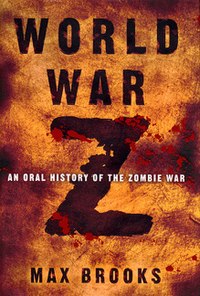
World War Z by Max Brooks

Book: World War Z
Author: Max Brooks

Why I Read It: Because I am a hard core zombie fan. And it looked awesome.
First Line: It goes by many names: "The Crisis," "The Dark Years," "The Walking Plague," as well as newer and more "hip" titles such as "World War Z" or "Z War One."

First Impression: Wow. This is really well written. And a brilliant idea.
Last Impression: Huh. Didn't really think about the impact of zombies on the planet. Or if they could survive drowning or freezing. A little more political than I was anticipating, but great angle to cover in an apocalyptic scenario.


Ratings
Overall – 5 Heart Racing
Characters – 5 Each and every character was unique and entralling; from regional accents to realistic slang, their voices jumped off the page.
Story – 5 The zombie apocalypse has been told many times, in many ways, ranging from horrorific to comedic, but this approach was brand new. Brooks is skilled in crafting a fluid narrative from the piece meal approach of first person accounts
Narration – 5 The journalistic structure of this "oral history" is well-crafted. The reader is drawn further in through each of the eight sections and the question and answer framework

Read Again? Absolutely. Willingly. Excitedly. And certainly around Halloween.
Tell Others to Read? Yes. Just about everyone. You don't have to be a zombie or horror fan to love this book. Also, you should stay ahead of the curve and read it before the movie comes out.

Excerpt: Two hundred million zombies. Who can even visualize that type of number, let alone combat it? At least this time around we knew what we were combating, but when you added up all the experience, all the data we'd compiled on their origin, their physiology, their strengths, their weaknesses, their motives, and their mentality, it still presented us with a very gloomy prospect for victory.
     The book of war, the one we've been writing since one ape slapped another, was completely useless in this situation. We had to write a new one from scratch.

An Abduction by Tessa Hadley

Jane Allsop was abducted when she was fifteen, and nobody noticed. This happened a long time ago, in Surrey, in the nineteen-sixties, when parents were more careless. She was home from boarding school for the summer, and day after day the sun rose into a cloudless sky, from which Jane couldn’t unfix the word “cerulean,” which she’d learned in the art room. (She wasn’t clever or literary, and was nervous of new words, which seemed to stick to her.) “Cerulean” was more of a blank, baking glare than mere merry blue.
 
It prised its way each morning like a chisel through the crack between Jane’s flowered bedroom curtains and between the eyelids she squeezed tightly shut in an effort to stay inside her dreams. It wasn’t acceptable in Jane’s kind of family to complain about good weather, yet the strain of it told on them, parents and children: they were remorselessly cheerful, while secretly they longed for rain. Jane imagined herself curled up with a bag of licorice beside a streaming windowpane, reading about the Chalet School. But her mother said it was a crime to stay indoors while the sun shone, and Jane couldn’t read outside with the same absorption; there was always some strikingly perfect speckled insect falling onto your page like a reminder (of what? of itself), or a root nudging into your back, or stinging ants inside your shorts.
 
The morning of the abduction, Mrs. Allsop—dishevelled in a limp linen shirtdress—was wielding her secateurs up a ladder, pruning the climbing roses. She was immensely capable; tall and big-boned with a pink, pleasant face and dry yellow hair chopped sensibly short. Jane admired her mother greatly, especially when she transformed herself at night, for a concert in London or a Rotary Club dinner, with clip-on pearl earrings and lipstick and scent, a frilled taupe satin stole. Jane coveted this stole and tried it on when her mother was at the shops, making sultry faces at herself in the mirror—although sultry was the last thing her mother was, and everyone told Jane that she looked just like her. She certainly seemed to have her mother’s figure, with not much bust, no waist to speak of, and a broad flat behind.

The Psychopath Test by Jon Ronson

Book: The Psychopath Test
Author: Jon Ronson

Why I Read It: I have quite the interesting in abnormal psychology and did a bit of research on the Hare Psychopath Checklist while working on my MA, so this title jumped off the shelf at me
First Line: This is a story about madness.

First Impression: Huh. Definitely not the way I thought this story would start.
Last Impression: It was interesting....I guess.


Ratings
Overall – 2 Faint Pulse
Characters – 2 There aren't characters, just real people interviewed who were sometimes given aliases to hid their identity. Ronson doesn't spend much time on descriptions of these people and as a results they feel rather flat.
Story – 2 The story starts in an unexpected and weak place for the expectations the title and cover imagery create, and since the ending is tied to the beginning it is not strong either. The rest of the novel is entertaining in rare moments and I learned a little, but overall I was underwhelmed.
Narration – 3 Ronson has skill with gathering the appropriate research, contacts and tidbits for his work, but they are tied together in a rather haphazard way, giving the novel an disjointed and disconnected feel.

Read Again? No. I read it once and now my curiosity is satisfied.
Tell Others to Read? No, probably not. There are other journalistic novelists that I would recommend first.

Excerpt: It was an awful lot harder, Tony told me, to convince people you're sane rather than it is to convince them you're crazy.
     "I thought the best way to seem normal," he said, "would be to talk to people normally about normal things like football and what's on TV. That's the obvious thing to do, right? I subscribe to New Scientist. I like reading about scientific breakthroughs. One time they had an article about how the U.S. Army was training bumblebees to sniff out explosives. So I said to a nurse, 'Did you know that the U.S. Army is training bumblebees to sniff out explosives?' Later when I read my medical notes, I saw they'd written, Thinks bees can sniff out explosives."

Good Neighbors by Jonathan Franzen

Walter and Patty Berglund were the young pioneers of Ramsey Hill—the first college grads to buy a house on Barrier Street since the old heart of St. Paul had fallen on hard times three decades earlier. The Berglunds paid nothing for their Victorian and then killed themselves for ten years renovating it.

Early on, some very determined person torched their garage and twice broke into their car before they got the garage rebuilt. Sunburned bikers descended on the vacant lot across the alley to drink Schlitz and grill knockwurst and rev engines at small hours until Patty went outside in sweatclothes and said, “Hey, you guys, you know what?”

Patty frightened nobody, but she’d been a standout athlete in high school and college and possessed a jock sort of fearlessness. From her first day in the neighborhood, she was helplessly conspicuous. Tall, ponytailed, absurdly young, pushing a stroller past stripped cars and broken beer bottles and barfed-upon old snow, she might have been carrying all the hours of her day in the string bags that hung from her stroller.

Behind her you could see the baby-encumbered preparations for a morning of baby-encumbered errands; ahead of her, an afternoon of public radio, “The Silver Palate Cookbook,” cloth diapers, drywall compound, and latex paint, and then “Goodnight Moon,” then Zinfandel. She was already fully the thing that was just starting to happen to the rest of the street.

In the earliest years, when you could still drive a Volvo 240 without feeling self-conscious, the collective task in Ramsey Hill was to relearn certain life skills that your own parents had fled to the suburbs specifically to unlearn, like how to interest the local cops in actually doing their job, and how to protect a bike from a highly motivated thief, and when to bother rousting a drunk from your lawn furniture, and how to encourage feral cats to shit in somebody else’s children’s sandbox, and how to determine whether a public school sucked too much to bother trying to fix it.

Creative Commons License
This work by H.E. Saunders is licensed under a Creative Commons Attribution-NonCommercial-NoDerivs 3.0 Unported License.