End of Eternity by Isaac Asimov

Book: The End of Eternity
Author: Isaac Asimov

Why I Read It: Because I am hard core addicted to anything Asimov writes.
First Line: Andrew Harlan stepped into the kettle.

First Impression: Huh. Seems a bit slower than most of Asimov's books.
Last Impression: Kinda bummed they gave the book this title. I knew the ending from about the halfway point.
 
Ratings
Overall – 3 Resting Heart Rate
Characters – 3 I love Asimov, but writing female characters has never been his strong suit, and it is certainly the case with the female love interest, Noys, in this novel. The main character Harlan is rather one dimensional and more of a plot device than a person you grow to care about.
Story – 3 Asimov created a unique story about time travel; Harlan exists in Eternity, which is outside of Time and allows people to travel parallel through Time. He falls into a love affair with Noys which makes him question the existence of Eternity and his purpose. The ending was given away by the title, but it was enjoyable to get there.
Narration – 3 The narration doesn't really pull you into the story, but the plot and the characters suffice to accomplish that instead.

Read Again? Perhaps. But I will read his sci-fi short story collections first when the itch for Asimov strikes. I am always glad to read his work but this isn't one of my favorites.
Tell Others to Read? If they are an Asimov fan and they haven't happened across this book, then yes. If they are just being introduced to Asimov, then no. I would steer them towards some of his more impactful works.

Excerpt: It was his hands acting by themselves that brought the kettle to the proper halt at the proper Century.
     Strange that a Technician should feel tense or nervous about anything. What was it that Educator Yarrow had once said:
     "Above all a Technician must be dispassionate. The Reality Change he initiates may affect the lives of as many as fifty billion people. A million or more of these may be so drastically affected as to be considered new individuals. Under these conditions, an emotional make-up is a distinct handicap."
     Harlan put the memory of his teacher's dry voice out of his mind with an almost savage shake of his head. In those days he never imagined that he himself would have the peculiar talent for that very position. But emotion had come upon him after all. Not for fifty billion people. What in Time did he care for fifty billion people? There was just one. One person.
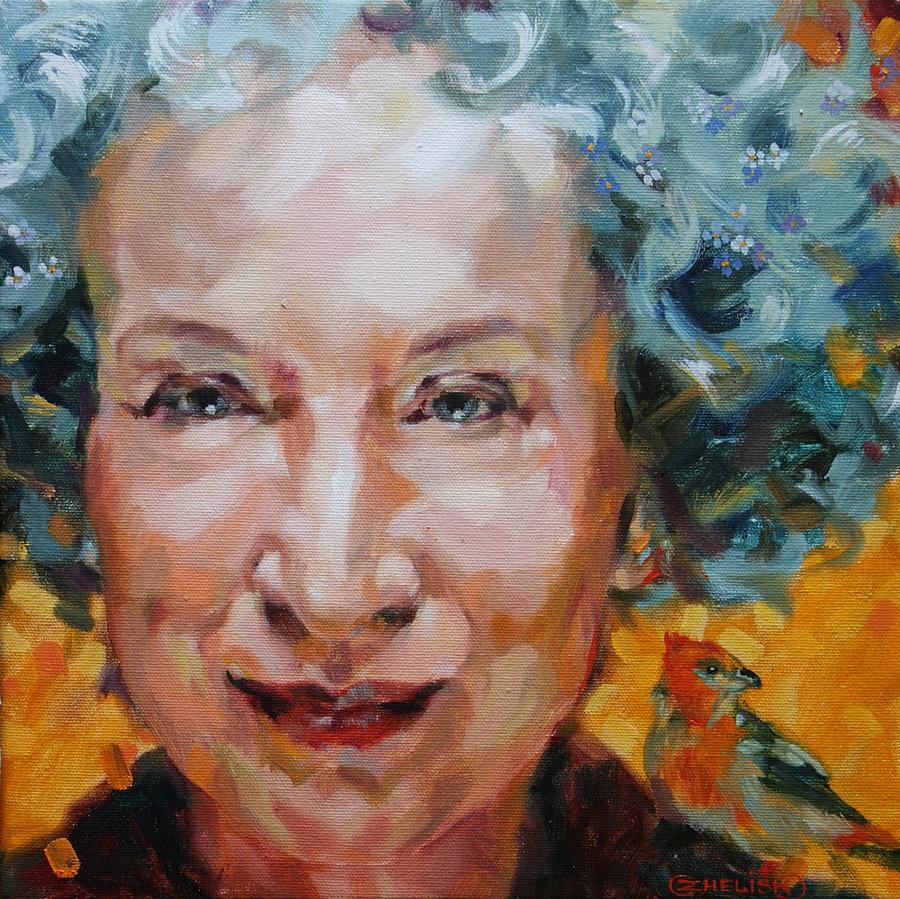
Pretend Blood by Margaret Atwood

Marla got into Past Lives through Sal. They were friends at work – they often had lunch together, and went shopping, and sometimes to movies, with nothing unusual being said.

But one day Sal confided to Marla that in a past life she'd been Cleopatra. The reason she was telling Marla this was that she'd just got engaged – out came a hulking diamond – because she'd run into a man through an internet chat site who'd been Marc Antony, and they'd got together in real life, and needless to say they'd fallen in love, and wasn't that wonderful?

Marla nearly choked on her coffee. First of all, if Sal had been Cleopatra she herself had been the Queen of Sheba, because Sal wasn't exactly anyone's idea of Miss Sexy Ancient Egypt – she was thirty-five and tubby, with a pasty complexion and an overbite. Also, Marla had seen that play – a long time ago, granted, but not so long that she didn't remember the death of Marc Antony, and also that of Cleopatra, what with the asps in a basket.

"It didn't end very well, the first time," she managed to croak out. It was cruel to laugh at someone else's nutty illusion, so she managed not to do that. Anyway, who was she to laugh? Nutty illusion or not, the Cleopatra thing had got results for Sal.

"That's true," Sal said. "It was awful at the time." She gave a little shudder. Then she explained that the good thing about having a past life was that you got the chance to return to earth as the same person you'd once been, but this time you could make things come out better. Which was why so many of the Past Lifers were historic figures who'd had tragic finales. A lot were from the Roman Empire, for instance. And kings and queens, and dukes and duchesses – they'd been prone to trouble because of their ambition and other people's jealousy of them and so forth.

Harry Potter Prequel for Charity by JK Rowling

The speeding motorcycle took the sharp corner so fast in the darkness that both policemen in the pursuing car shouted,”Whoa!”
 
Sergeant Fisher slammed his large foot on the brake, thinking that the boy who was riding pillion was sure to be flung under his wheels; however, the motorbike made the turn without seating either of its riders, and with a wink of its red tail lights, vanished up the narrow side street.
 
“We’ve got ‘em now!” cried PC Anderson excitedly. “That’s a dead end!”
 
Leaning hard on the steering wheel and crashing his gears, Fisher scraped half the paint off the flank of the car as he forced it up the alleyway in pursuit.There in the headlights sat their quarry, stationary at last after a quarter of an hour’s chase. The two riders were trapped between a towering brick wall and the police car, which was now crawling towards them like some growling luminous-eyes predator.

You Judge That Book By Its Cover

So, a long while ago, I decided that whole "don't judge a book by its cover" nonsense was just that; nonsense. My first outright disobedience to this archaic piece of wisdom proved very rewarding and since then I've never looked back. So as I scan my shelves looking for my next adventure, I start to look at books I've already devoured and and how much impact their cover had on my reading experience.

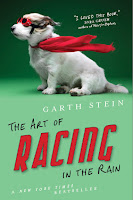
The first book that jumps out is The Art of Racing in the Rain. The story is about an old dog named Enzo who knows he is going to die (since he's getting up there in years) and all he wants is to be reincarnated as a racecar driver, like his owner Denny. It's a fine book. A quick read that is just right for someone who loves dogs or someone who is mildly fond of racing. But we're here to discuss the cover. If you haven't read the book, there's a (sorta) spoiler below, so just be warned. So, let's check out the differences, shall we?


The book on the left was what I saw throughout my reading experience. This cover of the book is very different from the new, more playful cover of the paperback version on the right. The second did not appear until long after I had closed the pages, and it got me wondering. How would I have read this book differently if Enzo had been looking at me like that? Probably very differently.

The dog on the left is looking away, unaware he's being seen. He's an adult and quite possibly old. There is no joy or happiness or puppy-ness on his face and instead he just looks tired. The dog on the right is engaging me; ears perked up, eyes on me, he looks curious as to what I am about to do. He may not be a puppy any longer, but he certainly looks young at heart.

Here's our spoiler: Enzo dies. Yes, I'm sure we all expected it to happen, but knowing can make it rough. Enzo knows it's coming but he's wishing for a happy reincarnation and a way back into Denny's life. The dog on the left prepared me for sadness; every time Enzo had an accident, was left abandoned or was in pain, my heart ached for him. I wish I would have been able to read it with the dog on the right greeting me. A dog that portrays optimism, hope, youthfulness and exuberance. This dog would have made the accidents, abandoning and pain a requisite necessity on his journey to a brighter (and hopefully faster) existence.

I wonder how Stein feels about his covers and if he knows what a somber overtone the looking-away Enzo cast over the reading experience. Perhaps that is why our new covers greet us cheerfully. But I know for certain that I wish the first time I read this book I was greeted by our youthful Enzo; perhaps then the feeling of subdued hopefulness would have easier to hold on to. Perhaps I'll pick the book up again, but if I do, you can bet I'm grabbing one of these sunnier and more adventurous covers!

Books That Take Me Places

Summer is drawing to a close, well, the summer of swimming pools, fireworks, barbeques and reunions. The blistering heat is still here. But the mood of summer is fading. Already it’s back-to-school-halloween-autumn in all the stores and all the travel plans are over. So every year, I fight back by embarking on a few last minute adventures from my library. I’ve compiled my favorite list of books that take me places. Now all you’ve got to decide is:

Where do you want to go?

Everywhere:
Read Travels by Michael Crichton. He ventures across the globe and into his psyche; literally everywhere. The narration mixes exotic explorations with personal discovery that makes for a seamless adventure read.

The most travelesque moment: the scuba diving section.


Travel Back in Time:
Read Water for Elephants by Sara Gruen. The circus-prohibition era just oozes off the page. The unique story and memorable characters are only part of the delight as she delicately recreates this age of wonder.

The most travelesque moment: the whole damn thing.


Travel To The Future:
Read Robots of Dawn by Isaac Asimov. Asimov walks the line between accessible and realistic; diehard sci-fi fans will love it and others will not be overwhelmed by scientific jargon. He creates a world that’s futuristic enough to be new, but same enough to be familiar.

The most travelesque moment: the main character’s life within the City.


Travel to a whole new crazy place:
Read Shades of Grey by Jasper Fforde. Fforde creates a chromatic society that is unexpected in a fun way. Spoons are a rare and cherished commodity, Greens don’t like Reds and no one likes Yellows and there is only one rabbit. Richly written and beautifully unique.

The most travelesque moment: the trek to a nearby uninhabited, dangerous town.


Travel to the afterlife:
Read The Lovely Bones by Alice Sebold. The journey from the living to the beyond is crafted with care and precision. Beautiful prose illuminates as unconscious expectations are realized; it's as if we always knew heaven would be like this.

The most travelesque moment: arriving in heaven.


So, whatever your inclination, we've got a destination.


Creative Commons License
This work by H.E. Saunders is licensed under a Creative Commons Attribution-NonCommercial-NoDerivs 3.0 Unported License.