Beyond The Door by Phillip K Dick

Larry Thomas bought a cuckoo clock for his wife--without knowing the price he would have to pay.
 
That night at the dinner table he brought it out and set it down beside her plate. Doris stared at it, her hand to her mouth. "My God, what is it?" She looked up at him, bright-eyed.

"Well, open it."
 
Doris tore the ribbon and paper from the square package with her sharp nails, her bosom rising and falling. Larry stood watching her as she lifted the lid. He lit a cigarette and leaned against the wall.
 
"A cuckoo clock!" Doris cried. "A real old cuckoo clock like my mother had." She turned the clock over and over. "Just like my mother had, when Pete was still alive." Her eyes sparkled with tears.
 
"It's made in Germany," Larry said. After a moment he added, "Carl got it for me wholesale. He knows some guy in the clock business. Otherwise I wouldn't have--" He stopped.

Doris made a funny little sound.
 
"I mean, otherwise I wouldn't have been able to afford it." He scowled. "What's the matter with you? You've got your clock, haven't you? Isn't that what you want?"
 
Doris sat holding onto the clock, her fingers pressed against the brown wood.
 
"Well," Larry said, "what's the matter?"
 
He watched in amazement as she leaped up and ran from the room, still clutching the clock. 
Introducing Monday Minis

To continue bringing you delighful readers something new and exciting to consume, The Dying Book Affair proudly presents Monday Minis! What better is there to start the week off right than to keep our desire to read still bubbling? Enter the #MondayMinis!

The more in-depth and comprehensive book reviews will still remain unrated, but the #MondayMinis are meant to be a quick glimpse and ratings are ideal for that purpose. Here is the rating system for our #MondayMinis.

Each mini review will include ratings for:
  • How much I liked it
  • Characters
  • Story
  • Narration
  • Overall

Ratings
  • 5 - Heart Racing. This was a great book! I am absolutely dying to read this book again. I will recommend it to everyone I know and random people I meet.
  • 4 - Heart Skipped a Beat. This book has something special. I will definitely read this book again. I will cheerfully recommend it.
  • 3 - Resting Heart Rate. This book was a good read overall but not particularly memorable. I won't read this book again unless a good reason pops up. I will only recommend this book if I think that particular individual might enjoy it.
  • 2 - Faint Pulse. This book tried, but didn't quite make it. I will not read this book again. I will not recommend it.
  • 1 - Flatlined. This book was terrible. I will never ever read this book again. I will not recommend it.

Now, not every book fits in this neat system. Every once in a while there is a book that invoke an extreme reaction. For those books we have....

Extreme ratings!
  • 6 - Heart Exploded with Joy. This book was fucking amazing. I am stunned with wonder. I wanted to read this book again immediately. I couldn't pick up another book for a while because this one had left such a strong impression. I will rave about this book to anyone who will stand still long enough.
  • 0 - Cold Dead Corpse. This book was a collossal waste of my time. I was powered only by stubbornness. I only finished this book because I refuse to leave any book unfinished but I did not enjoy it at all. I will actively tell people to avoid this book.

In addition to ratings, each review will have:
  • The title
  • The author's name
  • Why I read it
  • First Line
  • First Impression
  • Last Impression
  • If I will read it again
  • If I will tell others to read it
  • An excerpt

Now there is something delightful to look forward to every Monday morning! Enter your email to get The Dying Book Affair to your inbox or subscribe to get  Monday Minis delivered to you personally.

2 B R 0 2 B by Kurt Vonnegut

Everything was perfectly swell.

There were no prisons, no slums, no insane asylums, no cripples, no poverty, no wars.

All diseases were conquered. So was old age.

Death, barring accidents, was an adventure for volunteers.

The population of the United States was stabilized at forty-million souls.

One bright morning in the Chicago Lying-in Hospital, a man named Edward K. Wehling, Jr., waited for his wife to give birth. He was the only man waiting. Not many people were born a day any more.
 
Wehling was fifty-six, a mere stripling in a population whose average age was one hundred and twenty-nine.

X-rays had revealed that his wife was going to have triplets. The children would be his first.
Young Wehling was hunched in his chair, his head in his hand. He was so rumpled, so still and colorless as to be virtually invisible. His camouflage was perfect, since the waiting room had a disorderly and demoralized air, too. Chairs and ashtrays had been moved away from the walls. The floor was paved with spattered dropcloths.

The room was being redecorated. It was being redecorated as a memorial to a man who had volunteered to die.

A sardonic old man, about two hundred years old, sat on a stepladder, painting a mural he did not like. Back in the days when people aged visibly, his age would have been guessed at thirty-five or so. Aging had touched him that much before the cure for aging was found.

Introducing the Weekly Read

Here at The Dying Book Affair, we are all about a love of reading. A true, passionate affair with books, stories and all things literary. But not everyone has the same amount of time in their busy day-to-day adventures to pick up a book. But we will not let that stop the reading! So, every Wednesday will now be Short Story Wednesday and there will be a brand new #weeklyread available. 

Now your reading will not have to be a time-intensive commitment but rather can be a spur-of-the-moment pleasure. Each short story will be presented in its entirety and each Wednesday will bring a new story.

So get excited for next Wednesday and our first #weeklyread. And enjoy!

How To Know If You're Dead

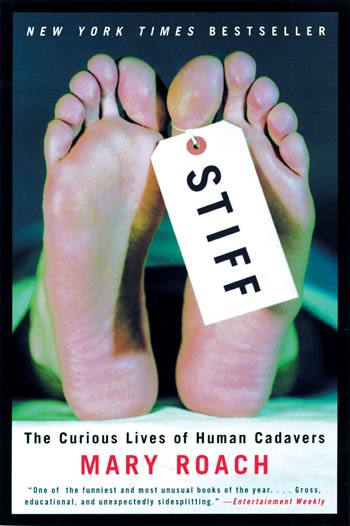
There are a lot of ways to tell if you're dead; heart not beating, the bright white light and seeing family members who have passed on. Or if there was absolutely no laughing while reading Mary Roach’s Stiff. That’s one sure-fire way to tell. Stiff: The Curious Lives of Human Cadavers uncovers the stories of the recently deceased and their fascinatingly gruesome history in a light-hearted way. But it is not for the faint of heart. The first line should prepare the reader for the rest of the journey: “The human head is of the same approximate size and weight as a roaster chicken.” Okay then.

The disgusting education continues from heads onto anatomy labs, the army, car crash tests and into the sticky subject of not-quite-dead cadavers. Each page has new tidbits and history, and with each fresh word the reader is learning without quite realizing it. And there is so much to learn. For instance, there are at least nine uses for a dead human that I bet no one has ever thought of before. Not only did Roach think of them, she investigated, illuminated and (dare I say) dissected each one.

The tone throughout this dissection is respectfully humorous, appropriately mirroring the attitude of the living who work with the dead. Roach handles the dead, and their keepers, with great care, making sure to never once cast a black shadow over this typically dark subject.

Reading Stiff is like traveling in a sidecar on Roach's journey; the reader experiences everything as she does, but once in a while she leans over to whisper something funny, slightly inappropriate and exactly what you were thinking. This book is written for the reader; unique photographs, footnotes at the foot of the page where they belong (unlike other books), and stories steeped in history.

The experience is more like a conversation with a friend than the one way dialogue of a novel. There is only one way this book will be read: voraciously.

Excerpt from Stiff: The Curious Lives of Human Cadavers
     Something else is going on. Squirming grains of rice are crowded into the man's belly button. It's a rice grain mosh pit. But rice grains do not move. These cannot be grains of rice. They are not. They are young flies. Entomologists have a name for young flies, but it is an ugly name, an insult. Let's not use the word "maggot." Let's use a pretty word. Let's use "hacienda."
     Arpad explains that the flies lay their eggs on the body's points of entry: the eyes, the mouth, open wounds, genitalia. Unlike older, larger haciendas, the little ones can't eat through skin. I make the mistake of asking Arpad what the little haciendas are after.
Creative Commons License
This work by H.E. Saunders is licensed under a Creative Commons Attribution-NonCommercial-NoDerivs 3.0 Unported License.